








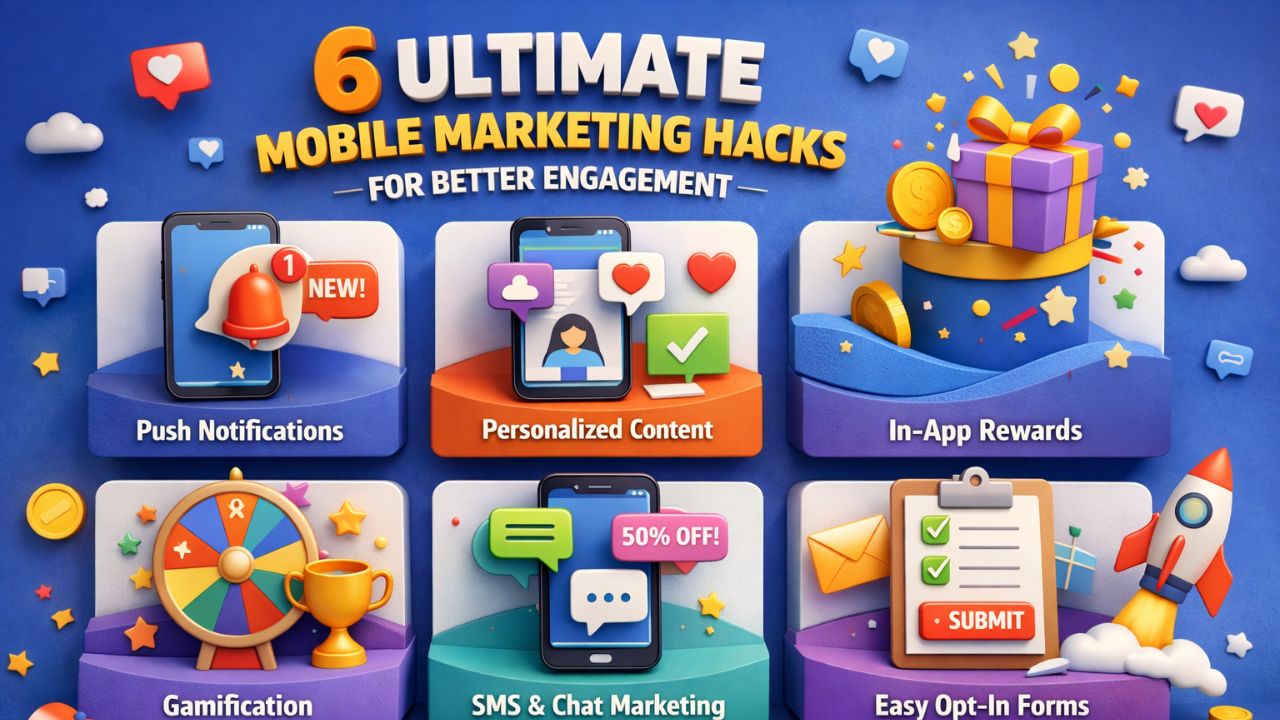
Mobile users don’t just browse anymore — they decide, compare, and convert in seconds. If your brand fails to engage them at the right moment, you lose attention instantly. That’s why Mobile Marketing is no longer about presence alone; it’s about relevance, timing, and value.
As user behavior shifts rapidly and platforms evolve, brands that rely on outdated tactics struggle to maintain engagement. Meanwhile, businesses that adapt their approach are seeing higher interaction rates, stronger loyalty, and measurable returns. This guide breaks down six proven mobile marketing hacks designed to help you drive better engagement in 2026 — whether you’re just starting out or refining an advanced strategy.
Table of Contents
Why Mobile Engagement Is Harder Than Ever (Yet Full of Opportunity)
User expectations have changed. People expect faster load times, hyper-personalized messages, and seamless experiences across devices. At the same time, stricter privacy rules and platform limitations make targeting more complex.
These mobile marketing challenges and solutions often revolve around the same core issues:
- Low engagement despite high reach
- Generic messaging that feels irrelevant
- Too many tools, not enough clarity
- Difficulty connecting engagement with revenue
The good news? Each challenge presents an opportunity. When brands focus on user intent instead of volume, engagement becomes predictable — and scalable.
Hack #1: Build a User-First Mobile Marketing Strategy
A strong mobile marketing strategy always begins with the user, not the channel.
Instead of asking, “Which platform should we use?”, the better question is, “How does our audience behave on mobile?” Understanding when users interact, what motivates them, and how they move from discovery to action sets the foundation for long-term engagement.
For those new to this space, these mobile marketing tips for beginners make a real difference:
- Prioritize one or two channels before expanding
- Focus on clarity over creativity
- Design every message for thumb-friendly interaction
- Test continuously rather than launching everything at once
When strategy aligns with real user behavior, engagement stops feeling forced — it becomes natural.
Hack #2: Learn from the Best Mobile Marketing Campaigns
High engagement rarely happens by accident. The best mobile marketing campaigns share a few common traits: relevance, timing, and consistency.
Successful campaigns don’t interrupt users; they complement what users are already doing. They leverage behavioral signals like browsing history, location, or previous interactions to deliver messages that feel helpful instead of intrusive.
What you can apply immediately:
- Send messages when users are most active
- Match tone to platform behavior
- Keep calls-to-action simple and action-oriented
- Optimize visuals for small screens
When campaigns feel personal rather than promotional, engagement follows naturally.
Hack #3: Use Automation Without Losing the Human Touch
Automation isn’t about replacing people — it’s about scaling relevance.
Modern mobile marketing automation tools help brands deliver timely messages without manual effort, but success depends on how thoughtfully they’re implemented. Automation should support personalization, not replace it.
The right mix of mobile marketing tools allows you to:
- Trigger messages based on user action
- Segment audiences dynamically
- Maintain consistency across touchpoints
- Reduce response delays
The key is balance. Automation handles speed and scale, while human insight ensures empathy and context. Together, they create experiences users actually want to engage with.
Hack #4: Optimize Mobile Marketing for Ecommerce Engagement
For online stores, engagement doesn’t stop at traffic — it must lead to action. Understanding how to do mobile marketing for ecommerce means mapping the entire mobile buyer journey.
Mobile shoppers behave differently than desktop users. They browse faster, abandon carts more often, and expect frictionless checkout experiences. Engagement strategies must account for this behavior.
Effective mobile ecommerce engagement focuses on:
- Clear product messaging
- Fast-loading pages
- Personalized reminders
- Seamless post-purchase communication
When each step feels effortless, users stay engaged longer and convert more confidently.
Hack #5: Track What Actually Matters with the Right Metrics
Engagement is meaningless if it doesn’t contribute to growth. That’s why tracking the right mobile marketing ROI metrics is essential.
Instead of relying on surface-level numbers, focus on metrics that reflect real impact:
- Engagement depth rather than impressions
- Repeat interactions instead of one-time clicks
- Conversion-assisted interactions
- Lifetime value influenced by mobile touchpoints
When you align engagement metrics with business goals, optimization becomes data-driven rather than guesswork.
Hack #6: Prepare for Mobile Marketing Trends Shaping 2026
The future belongs to brands that adapt early. Understanding mobile marketing trends 2026 gives you a strategic advantage before competition intensifies.
Key shifts already shaping engagement include:
- AI-driven personalization at scale
- Privacy-first data strategies
- Predictive engagement timing
- Deeper integration across devices
Brands that future-proof their approach today won’t need constant reinvention tomorrow.
Building Skills and Staying Ahead in Mobile Marketing
Technology evolves fast, and so should your knowledge. Many professionals turn to mobile marketing courses online to stay updated with platform changes, tools, and best practices.
Continuous learning helps you:
- Adapt to algorithm changes
- Understand new engagement formats
- Improve strategic decision-making
- Maintain long-term relevance
In a space that never stands still, learning becomes a competitive advantage.
Common Mobile Marketing Challenges (and Practical Solutions)
Even with the right strategy, obstacles are inevitable. The most common mobile marketing challenges and solutions revolve around execution and consistency.
Low engagement rates:
Refine targeting and messaging relevance.
Tool overload:
Simplify your stack and focus on integration.
Privacy concerns:
Adopt transparent, consent-based engagement practices.
Measurement confusion:
Align metrics with actual business outcomes.
Solving these issues systematically leads to sustainable engagement growth.
Final Thoughts
Mobile engagement isn’t about doing more — it’s about doing what matters. When strategy, personalization, automation, and measurement align, engagement becomes predictable rather than accidental.
These six mobile marketing hacks aren’t quick tricks; they’re long-term enablers. Apply them thoughtfully, adapt them continuously, and you’ll be positioned not just to compete — but to lead in 2026 and beyond.
Frequently Asked Questions
What is mobile marketing and why is it important in 2026?
Mobile marketing focuses on engaging users through smartphones and tablets using personalized, timely communication. In 2026, it’s essential because most digital interactions now happen on mobile devices, and users expect fast, relevant, and seamless experiences.
What are the best mobile marketing tips for beginners?
Beginners should start by understanding their audience’s mobile behavior, choosing one or two core channels, keeping messages short and clear, and optimizing every interaction for speed and usability. Consistent testing and gradual scaling are key.
How do I create an effective mobile marketing strategy?
An effective mobile marketing strategy starts with user intent. Define your audience, select channels based on behavior, personalize messaging, automate where appropriate, and track performance using engagement and revenue-focused metrics.
Which mobile marketing tools are best for improving engagement?
The best mobile marketing tools are those that support automation, personalization, analytics, and cross-channel consistency. Tools should simplify workflows, not complicate them, and integrate smoothly with your existing systems