






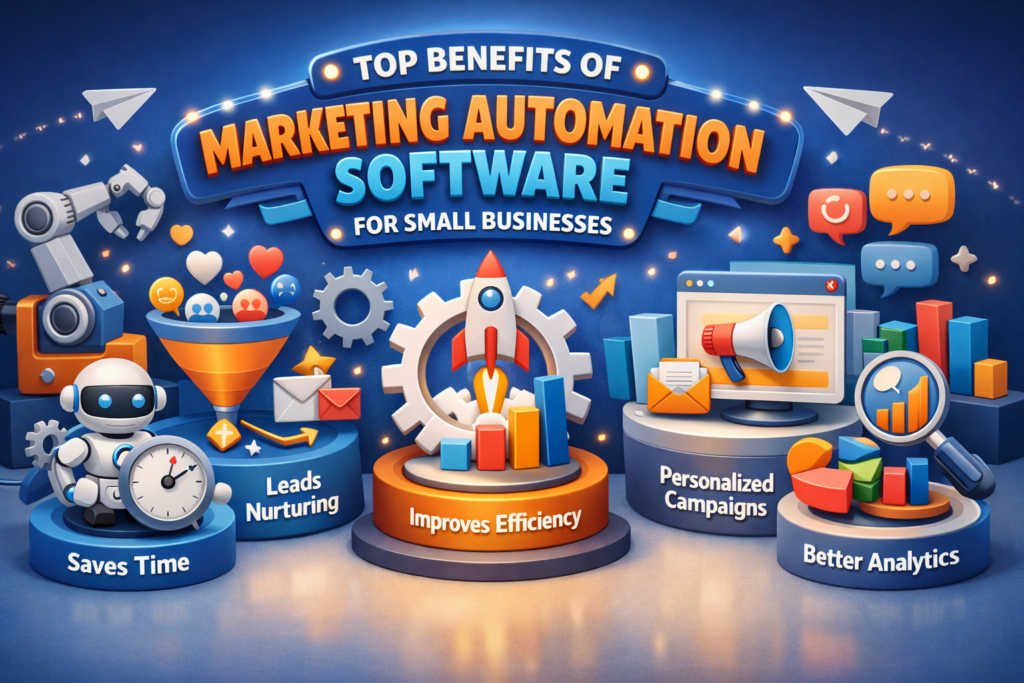
Running a small business today means juggling multiple responsibilities at once. You’re managing leads, nurturing customers, sending emails, tracking performance, and still trying to grow revenue. Doing all of this manually can slow you down and limit your ability to scale. This is exactly where Marketing Automation Software for Small Businesses becomes a powerful growth enabler.
Instead of working harder, automation helps you work smarter. It allows you to engage prospects consistently, respond to customer behavior in real time, and build long-term relationships without increasing workload. Let’s explore how automation is transforming small business marketing and why it’s becoming essential rather than optional.
Table of Contents
What Is Marketing Automation Software?
Before diving into the benefits, it’s important to understand what is marketing automation software and how it works.
Marketing automation software is a digital platform that helps businesses automate repetitive marketing tasks such as email campaigns, lead follow-ups, audience segmentation, and performance tracking. It collects user data, analyzes behavior, and triggers predefined actions based on that behavior.
For a growing company, marketing automation software acts as a centralized system that keeps marketing efforts organized, measurable, and scalable. Instead of manually managing each campaign, you can rely on automation to deliver the right message to the right audience at the right time.
Why Marketing Automation Matters for Small Businesses
Small businesses often operate with limited budgets and smaller teams. That’s why efficiency matters more than volume. Marketing automation small business strategies focus on maximizing output without increasing operational strain.
Automation helps you stay competitive with:
- Reducing time spent on repetitive tasks
- Improving response time to leads
- Maintaining consistent communication
- Supporting growth without additional hires
This makes Marketing Automation Software for Small Businesses, especially valuable in competitive digital environments where speed and personalization determine success.
Top Benefits of Marketing Automation Software for Small Businesses
When implemented correctly, automation delivers benefits that go far beyond convenience. Marketing Automation Software for Small Businesses supports long-term growth by improving both customer experience and internal efficiency.
Improved Lead Generation and Capture
Automation tools help you capture leads through landing pages, signup forms, and gated content. Once leads enter your system, they’re automatically categorized based on behavior, interests, or engagement levels.
This ensures that no opportunity slips through the cracks and every prospect receives timely attention. For stronger results, combine automation with lead generation strategies for business growth that cover audience targeting, lead qualification, nurturing, and conversion.
Marketing Automation for Lead Nurturing
One of the strongest advantages of automation is its ability to nurture leads consistently. Marketing automation for lead nurturing enables you to send targeted messages based on user behavior, such as website visits, email opens, or downloads.
Instead of generic outreach, prospects receive relevant content that matches their stage in the buying journey. This builds trust, improves engagement, and shortens sales cycles.
Higher Conversion Rates Through Timely Engagement
Automation allows you to respond instantly to user actions. Whether someone signs up for a newsletter or abandons a cart, the system can trigger follow-ups without delay.
These timely interactions often result in higher conversion rates because the message reaches users when their interest is highest. Over time, this directly impacts revenue growth.
Consistent and Personalized Communication
Consistency is difficult to maintain when campaigns are managed manually. Automation solves this by ensuring messages are delivered on schedule while still feeling personal.
Using customer data, you can personalize emails, offers, and content recommendations. This combination of consistency and personalization strengthens brand relationships and improves retention.
Measurable Results and Smarter Decisions
Another key advantage is access to detailed analytics. Marketing automation platforms track opens, clicks, conversions, and engagement patterns.
These insights help you refine campaigns, identify what works, and eliminate what doesn’t. This data-driven approach highlights the true marketing automation benefits for small business growth and optimization.
Email Marketing Automation Best Practices
Email remains one of the most effective digital channels when used correctly. Following proven email marketing automation best practices ensures higher engagement and better deliverability.
Key practices include:
- Segmenting email lists based on behavior and interests
- Personalizing subject lines and content
- Optimizing send times using engagement data
- Regularly testing content and formats
Automation ensures these best practices are applied consistently across all campaigns without extra effort.
Practical Marketing Automation Workflows Examples
Understanding how automation works in real scenarios makes implementation easier. These marketing automation workflows examples demonstrate common use cases for small businesses.
A welcome workflow introduces new subscribers to your brand through a sequence of emails. A re-engagement workflow reconnects with inactive users. Lead scoring workflows prioritize high-intent prospects for faster follow-up.
Each workflow works silently in the background, delivering value while saving time.
Choosing the Best Marketing Automation Tools for Startups
Selecting the right platform is crucial. The best marketing automation tools for startups focus on usability, scalability, and essential features rather than complexity.
Look for tools that offer:
- Easy setup and onboarding
- Email and lead management
- CRM integration
- Clear reporting dashboards
The goal is to adopt a solution that grows with your business without creating technical barriers. Automation works best when combined with broader low-cost startup marketing strategies that use content, email, and organic channels to support sustainable growth.
How to Compare Marketing Automation Platforms Effectively?
When evaluating options, it’s important to compare marketing automation platforms based on business needs rather than feature overload.
Consider pricing flexibility, customer support quality, automation depth, and integration capabilities. A well-matched platform ensures smoother adoption and better long-term performance.
This evaluation process is a critical step in making Marketing Automation Software for Small Businesses a sustainable investment.
How to Implement Marketing Automation Successfully?
Knowing how to implement marketing automation correctly can make the difference between success and frustration.
Start by identifying repetitive tasks, defining clear goals, and mapping customer journeys. Build simple workflows first, test performance, and gradually expand automation as you gain confidence.
Proper implementation ensures that automation enhances your strategy rather than complicating it.
Why Automation Is a Long-Term Growth Asset?
Beyond immediate efficiency, Marketing Automation Software for Small Businesses supports scalability. As your audience grows, automation ensures communication remains personalized and timely without increasing workload.
This long-term approach allows you to focus on strategy, innovation, and customer relationships while automation handles execution.
Future of Marketing Automation for Small Businesses
Automation continues to evolve with AI, predictive analytics, and advanced personalization. These innovations allow small businesses to compete with larger brands more effectively.
As these tools become more accessible, Marketing Automation Software for Small Businesses will play an even greater role in shaping digital growth strategies.
Frequently Asked Questions
What is marketing automation software used for?
It automates tasks like email marketing, lead nurturing, and campaign tracking to improve efficiency and engagement.
Is marketing automation suitable for small businesses?
Yes. Automation helps small teams achieve more without increasing costs or workload.
How long does it take to see results?
Most businesses notice improvements in engagement and efficiency within a few months of implementation.
Do small businesses need technical expertise to use automation?
Modern platforms are designed to be user-friendly and accessible even without technical backgrounds.
Conclusion
Growth doesn’t come from doing more manually. It comes from building systems that work for you. Marketing Automation Software for Small Businesses empowers you to engage customers consistently, nurture leads effectively, and scale marketing efforts with confidence.
By adopting automation strategically, you’re not just saving time. You’re creating a smarter, more sustainable path to long-term success.