






The e-commerce space is more competitive than ever. New brands launch daily, customer expectations keep rising, and platforms continuously update their algorithms. In this environment, relying on outdated tactics or isolated campaigns simply isn’t enough. What truly drives sustainable success today is a well-planned, data-backed approach built around e-commerce marketing strategies that focus on growth, conversions, and long-term customer value.
If you want consistent traffic, higher conversions, and repeat customers, you need a marketing framework that works across the entire buyer journey. This guide walks you through the high-impact e-commerce marketing strategies you need to stay competitive, scale efficiently, and build a brand that lasts.
Table of Contents
Why E-Commerce Marketing Strategies Matter More Than Ever?
Every online store competes for the same attention — search rankings, social feeds, inboxes, and paid placements. Without a clear plan, marketing efforts often become fragmented and inefficient. Strong e-commerce marketing strategies bring structure, clarity, and purpose to every action you take.
They help you:
- Attract the right audience
- Convert visitors into buyers
- Retain customers profitably
- Scale without increasing acquisition costs uncontrollably
In short, they turn marketing from an expense into a growth engine.
Understanding the Modern E-Commerce Ecosystem
Today’s customers don’t follow a straight line from product discovery to purchase. They compare, abandon carts, read reviews, and interact with brands across multiple channels before making a decision. That’s why modern e-commerce marketing strategies must be interconnected rather than siloed.
Success now depends on how well your SEO, content, email, social media, pricing, and conversion optimization work together. Each channel plays a role in influencing trust, intent, and action.
Building a Scalable E-Commerce Strategy Plan
Before launching campaigns, you need a clear roadmap. A strong e-commerce strategy eliminates guesswork and keeps your efforts aligned with business goals.
An effective e-commerce strategy plan template typically includes:
- Target audience and buyer personas
- Competitive and market analysis
- Channel prioritization
- Messaging and positioning
- Budget allocation
- KPIs and tracking metrics
When your strategy is documented and measurable, execution becomes far more efficient — and results become predictable.
High-Impact E-Commerce Growth Strategies
Growth isn’t just about driving more traffic. Sustainable expansion comes from balancing acquisition, conversion, and retention.
Smart e-commerce growth strategies focus on:
- Diversifying traffic sources to reduce dependency
- Expanding product visibility across search and social
- Increasing average order value
- Improving customer lifetime value
These growth levers work best when supported by solid e-commerce marketing strategies that adapt to changing customer behavior.
Smart E-Commerce Pricing Strategies That Drive Profitability
Pricing influences perception, trust, and purchase decisions. It’s not just about being cheaper — it’s about being strategic.
Effective e-commerce pricing strategies consider:
- Customer psychology and perceived value
- Competitive positioning
- Dynamic pricing based on demand
- Bundling and tiered offers
When pricing aligns with customer intent and brand positioning, it boosts both conversions and margins.
Conversion-Focused E-Commerce Marketing Strategies
Traffic alone doesn’t guarantee revenue. Conversion optimization bridges the gap between visits and sales.
High-performing e-commerce marketing strategies prioritize:
- Clean, intuitive user experience
- Fast-loading pages
- Clear product messaging
- Trust elements like reviews and guarantees
Well-executed e-commerce conversion rate strategies reduce friction and make it easier for users to complete purchases confidently.
Abandoned Cart Recovery Strategies That Reclaim Lost Revenue
Cart abandonment is one of the biggest challenges in e-commerce — but it’s also one of the biggest opportunities.
Proven abandoned cart recovery strategies include:
- Timely reminder emails
- Personalized messaging
- Incentive-based follow-ups
- Retargeting across channels
When implemented correctly, recovery campaigns can generate significant revenue without acquiring new traffic.
E-Commerce Customer Retention Strategies for Long-Term Growth
Acquiring new customers is expensive. Retaining existing ones is where profitability truly lies.
Strong e-commerce customer retention strategies focus on:
- Post-purchase engagement
- Personalized offers
- Loyalty programs
- Consistent brand communication
Retention-driven marketing not only increases repeat purchases but also strengthens brand trust and advocacy.
E-Commerce SEO Strategies That Attract High-Intent Traffic
Search remains one of the most powerful acquisition channels for online stores. However, ranking requires more than keyword stuffing.
Effective e-commerce SEO strategies involve:
- Optimizing product and category pages
- Structuring content around search intent
- Improving technical performance
- Building topical authority
SEO supports long-term visibility and plays a critical role in scalable e-commerce marketing strategies.
Building a High-Performing E-Commerce Content Strategy
Content educates, persuades, and builds trust — especially in competitive markets.
A strong e-commerce content strategy includes:
- Informational blog content
- Product-focused educational pages
- Comparison and buying guides
- Conversion-oriented landing pages
When content aligns with every stage of the buyer journey, it drives both organic traffic and sales.
E-Commerce Email Marketing Strategies That Convert
Email remains one of the highest ROI channels when used strategically.
High-impact e-commerce email marketing strategies focus on:
- Welcome and onboarding sequences
- Behavioral triggers
- Segmentation and personalization
- Lifecycle-based communication
Email also supports retention, cart recovery, and cross-selling efforts effectively.
Social Media Strategy for E-Commerce Brands
Social platforms are no longer just for engagement — they’re revenue drivers.
A successful social media strategy for e-commerce involves:
- Platform-specific content planning
- Balanced organic and paid promotion
- User-generated content integration
- Social commerce optimization
When social efforts align with broader e-commerce marketing strategies, they amplify reach and influence buying decisions.
Omnichannel Integration for Stronger Results
Customers expect consistency across touchpoints. Omnichannel marketing ensures every interaction feels connected.
Integrated e-commerce marketing strategies align:
- SEO and content
- Email and remarketing
- Social and paid advertising
- On-site experience
This unified approach improves customer experience and conversion efficiency.
Measuring and Optimizing E-Commerce Marketing Performance
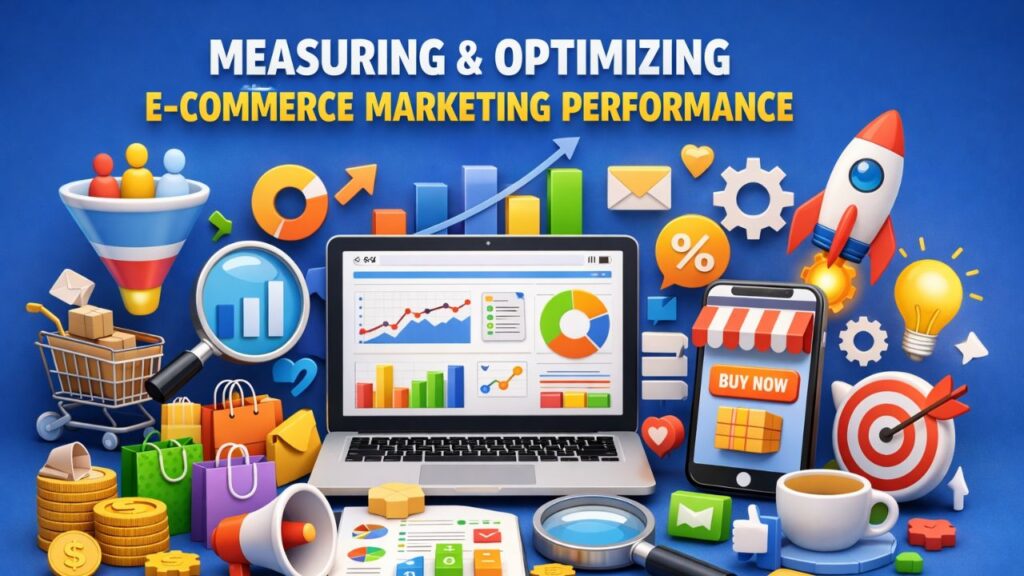
Data turns strategy into results. Tracking the right metrics allows you to optimize continuously.
Key areas to monitor include:
- Traffic quality and sources
- Conversion rates
- Customer lifetime value
- Retention and churn
Optimization ensures your e-commerce marketing strategies evolve alongside market trends and algorithm changes.
Common Mistakes to Avoid in E-Commerce Marketing
Many brands struggle not because of effort, but because of misalignment.
Common pitfalls include:
- Relying on a single traffic source
- Ignoring SEO and retention
- Poor funnel structure
- Short-term thinking
Avoiding these mistakes keeps your growth stable and scalable.
Future-Ready E-Commerce Marketing Strategies
The future belongs to brands that adapt quickly.
Emerging trends shaping e-commerce marketing strategies include:
- AI-driven personalization
- Predictive analytics
- Automation across channels
- Experience-led branding
Preparing early ensures long-term competitiveness.
Frequently Asked Questions
What are the most effective e-commerce marketing strategies today?
The most effective strategies combine SEO, content, conversion optimization, email marketing, and customer retention into a unified framework.
How do e-commerce SEO strategies help increase sales?
They attract high-intent traffic, improve visibility, and support long-term growth without ongoing ad spend.
Why are customer retention strategies important for e-commerce?
Retention lowers acquisition costs and increases lifetime value, making growth more profitable.
How do abandoned cart recovery strategies work?
They re-engage users who left without purchasing through personalized reminders and incentives.
What should an e-commerce strategy plan template include?
It should outline goals, channels, messaging, KPIs, and execution timelines
Final Thoughts
There’s no single tactic that guarantees success. Real results come from aligning multiple channels under a clear, data-driven plan. When executed correctly, e-commerce marketing strategies don’t just generate traffic — they build brands, loyalty, and long-term revenue.
If your goal is sustainable growth and first-page visibility, investing in the right strategy today will pay dividends tomorrow.