






Customer Journey Mapping has quietly become one of the most powerful growth tools in modern marketing. When you truly understand how people discover, evaluate, and interact with your brand, growth stops being guesswork and starts becoming predictable. Instead of pushing random campaigns, you begin designing experiences that guide customers smoothly from awareness to loyalty.
In this guide, you’ll learn practical, beginner-friendly ways to use Customer Journey Mapping to improve conversions, retention, and overall customer satisfaction. The focus is not theory-heavy frameworks, but actionable insights you can apply immediately—especially if you want sustainable, long-term growth.
Table of Contents
What Is Customer Journey Mapping?
Customer Journey Mapping is the process of visually representing every interaction a customer has with your brand across different stages of their lifecycle. It shows what users are doing, thinking, and feeling as they move from first contact to post-purchase engagement.
Unlike a traditional funnel that only tracks conversions, a customer experience journey map captures emotions, motivations, and friction points. This makes it especially valuable for improving experience, not just sales.
When done right, it helps you answer critical questions:
- Where do users get confused?
- Why do some prospects drop off?
- What moments build trust or break it?
Benefits of Customer Journey Mapping
Understanding the benefits of this journey makes it clear why high-growth businesses rely on it:
- Improved customer experience: You address real pain points instead of assumptions.
- Higher conversion rates: Removing friction increases the likelihood of action.
- Better alignment across teams: Marketing, sales, and support work toward the same goals.
- Stronger retention and loyalty: Customers feel understood, not sold to.
This journey gives you clarity, and clarity drives confident decision-making.
How to Create a Customer Journey Map
If you’re wondering how to create a customer journey map, the key is to start simple. You don’t need advanced tools or complex diagrams on day one.
Begin by identifying a single customer persona. Then outline the stages they move through—awareness, consideration, decision, and post-purchase. For each stage, document their actions, goals, emotions, and obstacles. This foundation makes the entire customer journey mapping process easier to manage and scale later.
Customer Journey Mapping Steps for Beginners
For beginners, following a clear structure helps avoid confusion. These customer journey mapping steps for beginners work across industries:
- Define your ideal customer persona
- Identify key touchpoints (website, ads, emails, support)
- Map customer actions at each stage
- Capture emotions, motivations, and concerns
- Highlight friction points and opportunities
This step-by-step approach ensures your map reflects reality, not internal assumptions.
Understanding the Customer Journey Mapping Process
The customer journey mapping process can be divided into four simple phases:
- Research: Gather data from analytics, feedback, and behavior patterns
- Mapping: Visualize stages, touchpoints, and emotions
- Validation: Cross-check insights with real user data
- Optimization: Improve weak points and enhance strong ones
Customer Journey Mapping is not a one-time exercise. It’s an evolving system that grows with your audience.
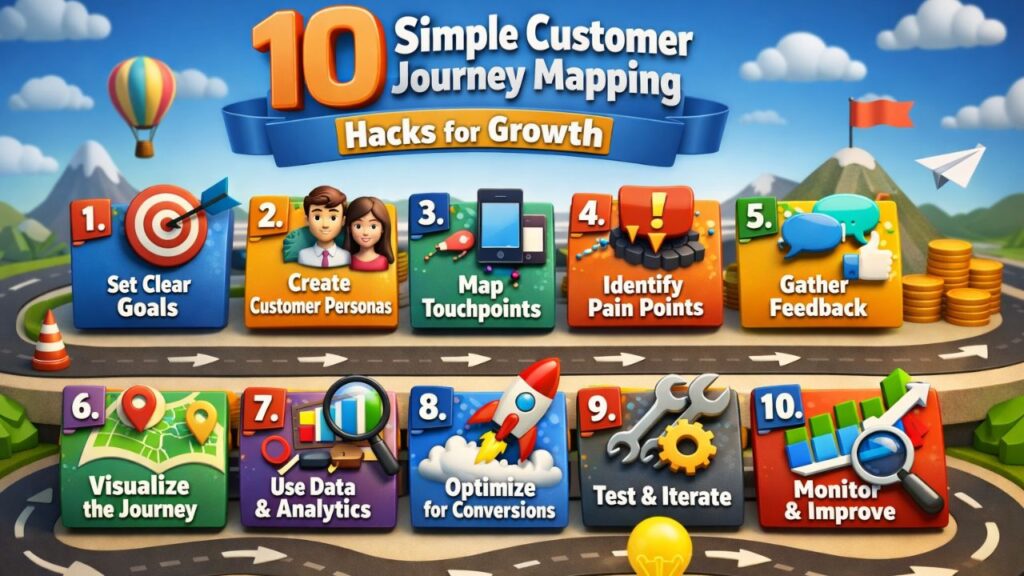
10 Simple Customer Journey Mapping Hacks for Growth
These hacks are designed to help you turn insights into measurable business impact.
1. Focus on One Persona at a Time
Trying to map everyone at once leads to vague insights. Customer Journey Mapping works best when you go deep into one specific persona.
2. Map Micro-Moments, Not Just Stages
Small interactions—like scrolling, hesitating, or comparing—often determine conversions. Capture them.
3. Track Emotions at Every Touchpoint
Growth happens when you reduce anxiety and increase confidence. Emotional data is critical.
4. Align Content With Each Stage
Your blog, landing pages, and emails should match where users are in their journey.
5. Use Real Customer Feedback
Surveys, reviews, and support tickets bring authenticity to Customer Journey Mapping.
6. Identify High-Friction Points First
Not all problems matter equally. Fix the biggest blockers before optimizing everything else.
7. Optimize for Mobile Journeys
Many journeys start and end on mobile. Map mobile-specific behaviors separately.
8. Connect Mapping With Analytics
Pair qualitative insights with quantitative data to validate assumptions.
9. Update Your Map Regularly
Customer behavior changes. Your journey map should too.
10. Turn Insights Into Action Plans
A journey map without execution is just a diagram. Assign clear actions to each insight.
Customer Journey Mapping Best Practices
Following proven customer journey mapping best practices helps maintain accuracy and impact:
- Keep maps simple and visual
- Base decisions on data, not opinions
- Collaborate across teams
- Focus on customer goals, not internal KPIs
Consistency matters more than perfection.
Customer Journey Mapping for Small Business
Customer journey mapping for small business owners is especially powerful because it maximizes limited resources. Instead of spreading efforts thin, you focus on the touchpoints that matter most.
Small teams can start with simple spreadsheets or whiteboards and still gain deep insights. The goal is clarity, not complexity.
Customer Journey Map Template: What to Include
A strong customer journey map template typically includes:
- Journey stages
- Customer actions
- Touchpoints
- Emotions and pain points
- Opportunities for improvement
Templates provide structure, but customization ensures relevance.
Examples of Customer Journey Maps
Examples of customer journey maps often include:
- Awareness-to-purchase journeys
- Onboarding journeys
- Retention and loyalty journeys
Reviewing different examples helps you understand how flexible Customer Journey Mapping can be across scenarios.
Customer Journey Mapping Tools
There are many customer journey mapping tools available today. Some focus on visualization, while others integrate analytics and feedback.
Choose tools based on your team size, goals, and technical comfort. Tools should support your process, not complicate it.
Common Mistakes to Avoid
- Overcomplicating the map
- Ignoring post-purchase stages
- Failing to update insights
Avoiding these mistakes keeps Customer Journey Mapping actionable and trustworthy.
How Customer Journey Mapping Supports Long-Term Growth?
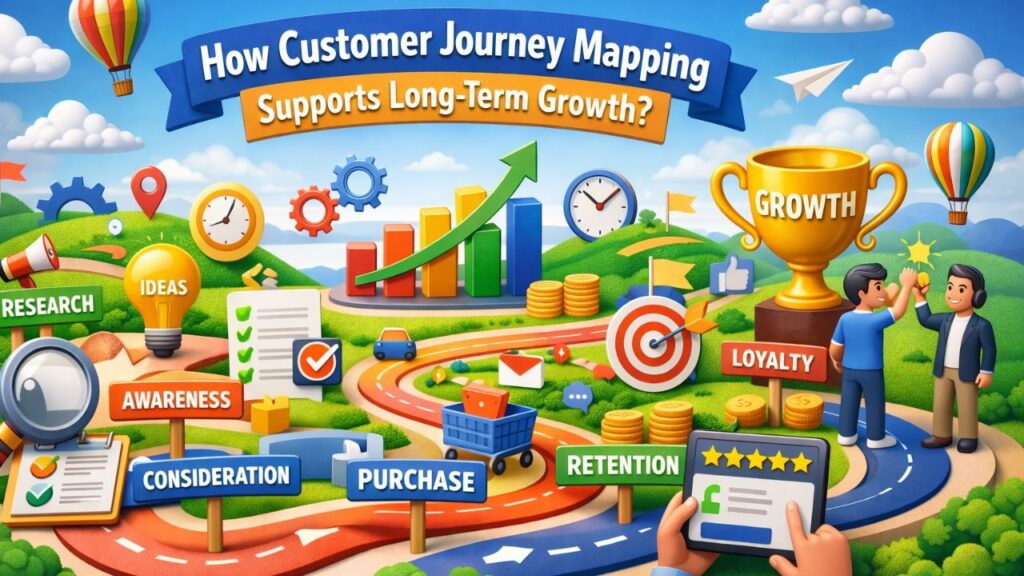
Customer Journey Mapping helps you move from reactive marketing to proactive experience design. By understanding behavior patterns, you can predict needs, personalize interactions, and build lasting trust.
Growth becomes a byproduct of better experiences—not aggressive selling.
Final Thoughts
Customer Journey Mapping is not just a marketing exercise—it’s a growth mindset. When you commit to understanding your customers at every stage, you unlock clarity, confidence, and consistency in your decisions.
By applying these simple hacks and best practices, you can turn your customer journey map into a powerful engine for sustainable business growth.
Frequently Asked Questions
What is a customer journey map?
A customer journey map is a visual representation of how a user interacts with a brand across different stages, from first awareness to post-purchase engagement. It highlights actions, touchpoints, emotions, and challenges so businesses can improve the overall experience.
How long does it take to create a customer journey map?
The time required depends on the depth of research and complexity of the business. A basic journey map can be created in a few hours, while a detailed version involving data analysis and feedback may take several days.
What data is needed to build an effective journey map?
Useful data sources include website analytics, customer feedback, surveys, CRM data, support tickets, and behavioral insights. Combining qualitative and quantitative data leads to more accurate mapping.
Is customer journey mapping useful for small businesses?
Yes, it is highly effective for small businesses because it helps prioritize the most important touchpoints. With limited resources, understanding where customers face friction allows small teams to focus on high-impact improvements.
How often should a customer journey map be updated?
Journey maps should be reviewed regularly—typically every quarter or whenever there is a major change in products, services, or customer behavior. Regular updates ensure the insights remain relevant.
What is the difference between a funnel and a journey map?
A funnel focuses mainly on conversions, while a journey map captures the full customer experience, including emotions, motivations, and post-purchase interactions. This makes journey mapping more holistic.
Are templates reliable for journey mapping?
Templates provide a helpful starting point, especially for beginners. However, they should always be customized to reflect real customer behavior and business goals.
Can journey mapping improve conversions?
Yes, by identifying friction points and optimizing key touchpoints, journey mapping helps reduce drop-offs and guides users more smoothly toward desired actions.