







Marketing today moves fast. Customers expect instant responses, personalized experiences, and consistent engagement across every platform. At the same time, small teams are expected to do more with fewer resources. This is exactly where marketing automation software changes the game.
If you want scalable growth without burning out your team, automation isn’t optional anymore — it’s essential. In this in-depth guide, you’ll learn how automation fuels business growth, how to implement it properly, and how to choose the right tools.
This guide is designed for startups, marketers, founders, and growing businesses that want predictable and sustainable growth.
Table of Contents
What Is Marketing Automation Software?
Before diving into strategies, let’s answer a core question: what is marketing automation software?
Marketing automation refers to technology that automates repetitive marketing tasks such as email campaigns, lead nurturing, customer segmentation, and analytics tracking. Instead of manually sending emails or tracking leads in spreadsheets, automation platforms manage these tasks using triggers, workflows, and behavioral data.
Key components include:
- Email automation
- Lead scoring and segmentation
- CRM integrations
- Campaign tracking
- Workflow automation
- Analytics and reporting
In simple terms, automation helps businesses deliver the right message to the right person at the right time — without manual effort.
Why Marketing Automation Essential Today?
Customer journeys are no longer simple. Buyers research, compare, and interact across multiple channels before making decisions.
Key reasons automation is growing rapidly:
- Customers expect personalized communication
- Businesses need real-time engagement
- Marketing teams must scale without increasing headcount
- Data-driven marketing has become the standard
These shifts explain the rising adoption of marketing automation software across industries.
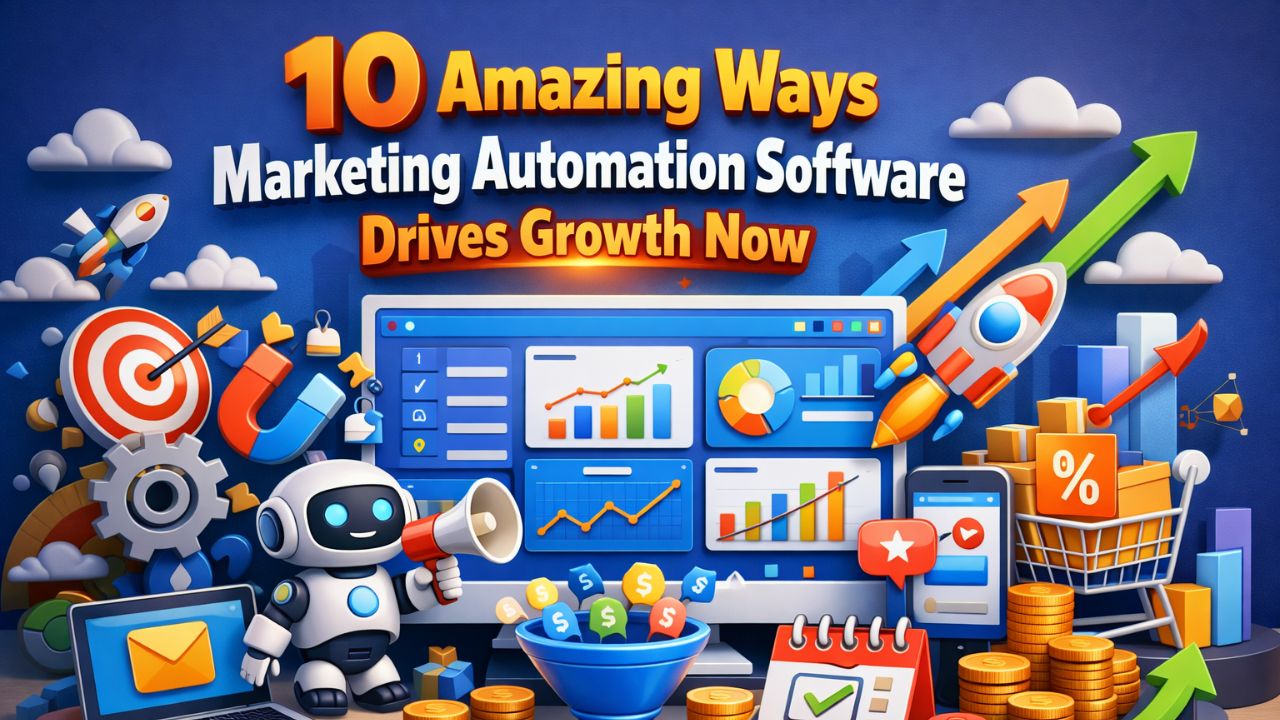
10 Amazing Ways Marketing Automation Software Drives Growth
1. Automates Lead Generation at Scale
Lead generation used to require manual effort. Today, automation captures leads 24/7 through:
- Smart forms
- Landing pages
- Chatbots
- Social integrations
With automation running in the background, businesses can focus on strategy while leads continue flowing in consistently.
2. Improves Lead Nurturing & Conversion
One of the biggest benefits is marketing automation for lead nurturing.
Most leads aren’t ready to buy immediately. Automation nurtures them through:
- Drip email campaigns
- Behavior-based messaging
- Lead scoring systems
- Personalized offers
This gradual approach builds trust and moves prospects closer to purchase decisions.
3. Enhances Email Marketing Performance
Email remains one of the highest ROI channels. Following email marketing automation best practices ensures consistent engagement.
Automation enables:
- Welcome sequences
- Abandoned cart emails
- Re-engagement campaigns
- Personalized newsletters
Instead of sending mass emails, businesses can deliver targeted messages that truly resonate.
4. Saves Time and Reduces Marketing Costs
Automation eliminates repetitive tasks like:
- Sending follow-up emails
- Posting social content
- Tracking campaign performance
For startups and small teams, the marketing automation benefits for small business are enormous. You can scale operations without increasing payroll.
5. Enables Data-Driven Decision Making
Modern platforms provide real-time insights:
- Campaign performance metrics
- User behavior tracking
- Conversion analytics
- Predictive insights
This data helps marketers make smarter decisions and continuously optimize strategies.
6. Improves Customer Journey Mapping
Automation creates seamless multi-channel experiences:
- Email + social + website integration
- Personalized lifecycle messaging
- Automated onboarding and retention campaigns
This ensures customers receive consistent messaging across every touchpoint.
7. Boosts Social Media Marketing Efficiency
Automation tools help schedule posts, track engagement, and monitor performance.
Benefits include:
- Consistent posting
- Automated campaign tracking
- Social listening features
- Cross-platform publishing
This makes social media more strategic and less time-consuming.
8. Strengthens Sales and Marketing Alignment
Automation bridges the gap between marketing and sales.
Key improvements:
- Automated lead handoff
- CRM integration
- Pipeline tracking
- Shorter sales cycles
When teams work together seamlessly, conversions increase.
9. Scales Marketing for Startups & SMBs
Marketing Automation Software for Small Businesses allows growth without massive budgets.
Startups can:
- Launch campaigns quickly
- Manage customer journeys efficiently
- Compete with larger companies
This scalability makes automation a must-have for modern startups.
10. Improves Customer Retention and Loyalty
Growth isn’t only about new customers. Automation supports retention through:
- Onboarding workflows
- Feedback surveys
- Loyalty campaigns
- Upsell and cross-sell automation
Happy customers become repeat buyers and brand advocates.
How to Implement Marketing Automation Step-by-Step?
If you’re wondering how to implement marketing automation, follow this roadmap:
Step 1: Define Goals and KPIs
Clarify what you want to achieve:
- Lead generation
- Customer retention
- Conversion optimization
Step 2: Map Customer Journeys
Understand how prospects move from awareness to purchase.
Step 3: Choose the Right Platform
Consider budget, integrations, and scalability.
Step 4: Create Automation Workflows
Build workflows based on customer behavior.
Step 5: Integrate CRM and Analytics
Ensure data flows across systems.
Step 6: Test and Optimize
Automation improves with continuous testing.
Marketing Automation Workflows Examples
Here are proven marketing automation workflows examples:
Welcome Workflow
Trigger: New subscriber
Action: Send welcome email series
Lead Nurturing Workflow
Trigger: Downloaded resource
Action: Send educational content sequence
Webinar Funnel Workflow
Trigger: Webinar registration
Action: Reminder emails + follow-up offers
Re-engagement Workflow
Trigger: Inactive subscribers
Action: Special offers + surveys
Post-Purchase Workflow
Trigger: Completed purchase
Action: Upsell and feedback emails
How to Compare Marketing Automation Platforms?
When you compare marketing automation platforms, evaluate:
- Ease of use
- Pricing structure
- Integrations
- Reporting capabilities
- Automation features
- Scalability
Choosing the right platform ensures long-term success.
Best Marketing Automation Tools for Startups
When evaluating the best marketing automation tools for startups, prioritize:
- Affordable pricing
- Email automation
- CRM integrations
- Workflow builders
- Analytics dashboards
Startups need tools that balance cost and scalability.
Common Mistakes to Avoid
Even the best marketing automation software fails without proper strategy.
Avoid these mistakes:
- Over-automation without personalization
- Poor segmentation
- Ignoring analytics
- Lack of testing
- Sending too many emails
Automation should feel human, not robotic.
Future of Marketing Automation
Automation continues evolving with:
- AI-driven personalization
- Predictive analytics
- Omnichannel engagement
- Privacy-first data strategies
Businesses that adopt early will gain a competitive advantage.
Conclusion
Growth today requires smarter marketing, not just more marketing. When used strategically, marketing automation software helps businesses attract leads, nurture relationships, and convert customers at scale.
If you want consistent growth, automation isn’t just helpful — it’s essential.
FAQs
What is marketing automation software?
It’s technology that automates marketing tasks like email campaigns, lead nurturing, and analytics tracking.
Is marketing automation worth it for small businesses?
Yes. The marketing automation benefits for small business include cost savings, improved efficiency, and better lead management.
How long does it take to see results?
Most businesses begin seeing measurable improvements within 3–6 months.
What is the best marketing automation strategy?
Start with lead generation and nurturing workflows, then expand to retention and analytics.
How much does marketing automation cost?
Costs vary based on features, integrations, and business size. Many tools offer scalable pricing for startups and growing companies.