












If you are building websites, you are not just writing code. You are shaping how search engines understand, crawl, and rank your content. That is where a strong technical SEO guide becomes essential.
Developers play a direct role in search performance. From page speed to indexing signals, every technical decision impacts visibility. While many focus on content, the real foundation lies in how well your site is structured.
Before going deeper, it is important to understand SEO Basics. These fundamentals help you connect development decisions with search engine behavior. When you combine both, you create a system that performs consistently in search results.
Table of Contents
How Search Engines Crawl, Render, and Index Websites?
Search engines like Google use a structured process to understand and rank your website. Every technical SEO guide begins with mastering this flow because it directly impacts visibility, rankings, and discoverability.
The process happens in three core stages:
- Crawling
- Rendering
- Indexing
Let’s break each step down in a simple, practical way.
Crawling: How Search Engines Discover Your Pages
Crawling is the first step where search engine bots (also called spiders) scan your website to find pages.
How it works:
- Bots follow internal and external links
- They move from one page to another through hyperlinks
- XML sitemaps also help guide bots
Key Insight:
If your site has weak internal linking, many pages may remain undiscovered. Even high-quality content can fail if bots cannot find it.
Optimization Tips:
- Build strong internal linking
- Use a clean URL structure
- Submit an XML sitemap
- Avoid orphan pages
A well-structured internal linking strategy is a foundational element of any effective technical SEO guide.
Rendering: How Search Engines Understand Your Content?
Rendering is where search engines process your page visually and structurally, similar to how a browser does.
Why it matters:
Modern websites rely heavily on JavaScript. Search engines must execute this code to fully see your content.
Common Issues:
- Content hidden behind JavaScript
- Slow-loading scripts
- Blocked resources (CSS, JS files)
If rendering fails, search engines may only see a blank or incomplete page.
Optimization Tips:
- Use server-side rendering (SSR) or pre-rendering
- Ensure important content is visible without heavy JS
- Allow bots to access CSS and JavaScript files
A strong technical SEO guide always emphasizes rendering because unrendered content is essentially invisible to search engines.
Indexing: How Pages Get Stored and Ranked?
Indexing is the final step where search engines decide whether to store your page in their database.
Crawl budget plays a critical role when your website grows. Search engines allocate limited resources to crawl your pages.Indexing Control and Robots Management
Controlling indexing is critical for technical SEO.
Best practices:
- Use robots.txt to manage crawling
- Use noindex for unnecessary pages
- Submit XML sitemaps
- Avoid blocking important resources
Proper control ensures search engines index only valuable content.
What happens here?
- Content is analyzed
- Quality signals are evaluated
- Pages are added (or rejected) from the index
Why pages may not get indexed?
- Thin or duplicate content
- Poor internal linking
- Noindex tags
- Weak authority signals
If your page is not indexed, it will never appear in search results.
Optimization Tips:
- Use unique, high-quality content
- Fix duplicate content issues
- Ensure proper canonical tags
- Monitor indexing in Google Search Console
Any advanced technical SEO guide prioritizes indexing because it directly determines whether your content can rank.
Advanced Crawl Budget Optimization for Large Websites
To optimize crawl budget effectively:
- Remove or block low-value pages using robots.txt
- Fix broken links and redirect chains
- Use XML sitemaps to highlight priority pages
- Avoid duplicate URLs and parameters
Search engines prioritize high-value pages. If your crawl budget is wasted, important pages may never get indexed.
Indexing Control and Robots Management
Controlling indexing is critical for technical SEO.
Best practices:
- Use robots.txt to manage crawling
- Use noindex for unnecessary pages
- Submit XML sitemaps
- Avoid blocking important resources
Proper control ensures search engines index only valuable content.
Why This Process Matters for Rankings?
If you want better rankings, you must control how search engine bots interact with your website.
Here’s the simple truth:
- No crawl → No discovery
- No render → No understanding
- No index → No ranking
Each stage builds on the previous one. A failure at any step breaks the entire SEO pipeline.
Structured Content and Voice Search Advantage

Search engines prefer content that is:
- Well-structured
- Clearly formatted
- Easy to interpret
This is especially important for voice search optimization.
When your content is structured properly:
- It becomes easier for search engines to extract answers
- It improves your chances of appearing in featured snippets
- It increases visibility in voice search results
A modern technical SEO guide always includes structured data, headings, and semantic clarity to align with how search engines interpret content.
Website Architecture and URL Optimization
A well-structured website improves both user experience and crawl efficiency.
Best Practices
- Keep URLs short and meaningful
- Avoid unnecessary parameters
- Use logical folder structures
- Maintain a shallow site depth
A strong architecture ensures every page is accessible within a few clicks. This is a core principle in any technical SEO guide.
Internal Linking Strategy
- Link relevant pages contextually
- Use descriptive anchor text
- Avoid orphan pages
GEO Optimization Tip:
If you are targeting locations, structure URLs with geographic relevance to improve local rankings.
Core Web Vitals and Page Experience
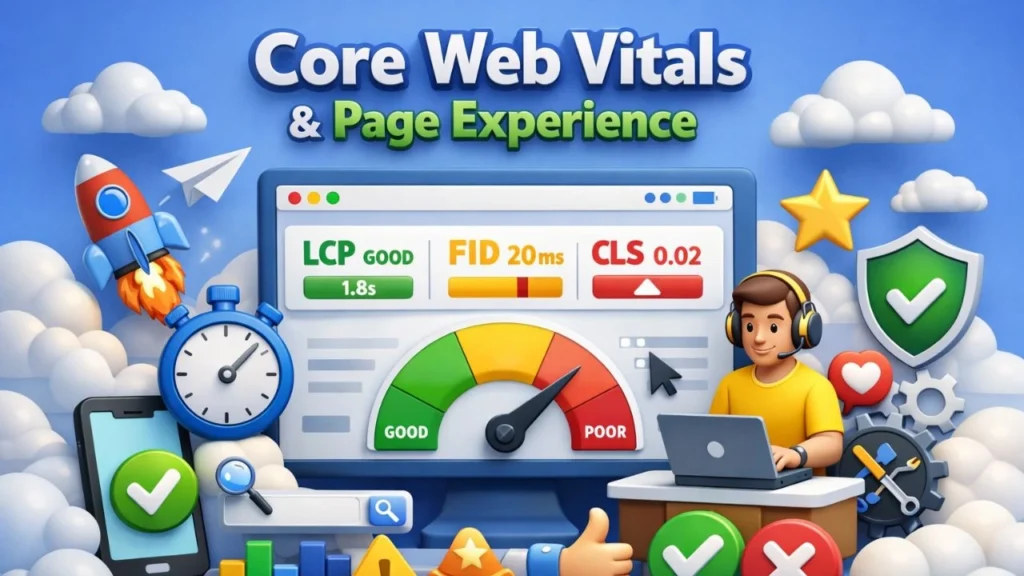
Performance is no longer optional. It directly impacts rankings.
Key Metrics
- Largest Contentful Paint (LCP)
- Interaction to Next Paint (INP)
- Cumulative Layout Shift (CLS)
Improving these metrics requires developer-level optimization.
What You Can Do
- Optimize images
- Reduce JavaScript execution
- Use efficient caching
- Implement a content delivery network
A fast website not only ranks better but also keeps users engaged.
Advanced On Page Technical Elements
Your code directly communicates with search engines.
Essential Components
- Canonical tags to prevent duplication
- Robots directives to control crawling
- XML sitemaps for discovery
- Hreflang for international targeting
Every element in this technical SEO guide ensures clarity for search engines.
AEO Tip:
Use structured headings and direct answers. This helps your content appear in featured snippets.
JavaScript SEO for Modern Applications
Modern frameworks create powerful interfaces, but they can create SEO challenges.
Common Issues
- Content not visible in initial HTML
- Delayed rendering
- Blocked resources
Solutions
- Use server side rendering
- Implement dynamic rendering when needed
- Ensure critical content loads instantly
If search engines cannot access your content, rankings will suffer.
Structured Data and Schema Implementation

Structured data helps search engines understand your content better.
Benefits
- Rich results
- Enhanced visibility
- Better click-through rates
Best Practices
- Use JSON LD format
- Validate schema regularly
- Apply relevant schema types
Voice Search Advantage:
Structured data improves your chances of answering conversational queries.
Technical SEO for Large Websites
Scaling introduces complexity.
Challenges
- Duplicate content
- Crawl inefficiencies
- Indexing delays
Solutions
- Optimize crawl budget
- Control faceted navigation
- Use log file analysis
A well-managed structure ensures search engines focus on your most important pages.
Mobile Optimization and Progressive Web Apps
Search engines prioritize mobile-first indexing.
What Matters
- Responsive design
- Fast mobile loading
- Clean navigation
Progressive Web Apps can improve engagement and performance when implemented correctly.
Security and HTTPS Optimization
Security builds trust with both users and search engines.
Key Actions
- Use HTTPS across all pages
- Fix mixed content issues
- Implement secure headers
A secure site strengthens your SEO foundation.
Advanced Internal Linking Strategy
Internal links distribute authority across your site.
Best Practices
- Link high authority pages to important pages
- Use natural anchor text
- Maintain contextual relevance
Strong internal linking improves both rankings and user navigation.
Monitoring and Debugging Technical SEO
Continuous monitoring is essential.
What to Track
- Index coverage
- Crawl errors
- Page performance
Tools You Should Use
- Google Search Console
- Performance monitoring tools
- Log analysis tools
A successful technical SEO guide is never static. It evolves with data.
Common Technical SEO Mistakes to Avoid
Even small mistakes can impact rankings.
- Blocking important pages
- Incorrect canonical implementation
- Slow loading scripts
- Ignoring mobile usability
Fixing these issues can lead to immediate improvements.
Future of Technical SEO for Developers
Search is evolving rapidly.
Key Trends
- AI driven search systems
- Smarter crawling behavior
- Increased focus on user experience
Developers who adapt early will gain a strong competitive advantage.
Conclusion
Technical SEO is not just a checklist. It is a continuous process that connects development with search performance. When you follow a structured technical SEO guide, you build a website that search engines trust and users prefer.
If you focus on performance, structure, and accessibility, you will not just rank better. You will create a system that grows consistently.
FAQs
What is a technical SEO guide?
A technical SEO guide helps you optimize website structure, speed, and indexing to improve search visibility.
Why should developers care about SEO Basics?
SEO Basics help developers understand how their code impacts crawling, indexing, and ranking.
How can I improve my website’s crawlability?
Use proper internal linking, clean URLs, and updated sitemaps to guide search engines effectively.
Does page speed affect rankings?
Yes, faster websites provide better user experience and are favored by search engines.
What is the role of structured data in SEO?
Structured data helps search engines interpret content and display enhanced results in SERPs.
